
Water changes ground behaviour. It softens footwall, opens joints, washes fines out of broken ground and reduces the friction the rock mass was relying on. Support that was adequate in dry conditions is not automatically adequate once the same excavation is wet.
Temporary support is where that difference shows up first, because it is installed quickly, in the working area, often in the conditions that made it necessary.
How water changes ground conditions
Water affects the rock mass in several ways at once, and the effects compound. Joints that were tight open as fines are washed out, so blocks that were keyed in become free to move. Softened footwall lets support punch in, so a prop that was correctly tensioned loses its load. Freshly exposed faces deteriorate faster when wet, so the time available between exposure and support shortens.
The practical implication is that support decisions in wet ground have a shorter shelf life. What was inspected and found sound last week is not necessarily sound now, and the interval that matters is set by the water, not the calendar.
- Fines washed from joints free blocks that were previously keyed
- Softened footwall allows support to punch in and shed load
- Exposed faces deteriorate faster once continuously wet
- Load can transfer unpredictably as adjacent ground moves
- Inspection intervals must shorten where conditions are deteriorating
What temporary support has to achieve
Temporary support has one purpose: to make the working area safe for the period between exposure and permanent support. To do that it must be installable quickly by the crew present, be capable of carrying the load where the footwall is not ideal, hold its load as ground moves, and be recoverable so that cost does not discourage its use.
That last point matters more than it sounds. Support that is expensive or difficult to recover gets used sparingly, and support used sparingly does not protect anybody.
- Installable quickly by the crew already in the working area
- Adequate bearing where the footwall is soft or uneven
- Holds load as adjacent ground moves or deteriorates
- Recoverable and reusable, so it is used freely rather than rationed
- Simple enough to install correctly under pressure
Installation practice in wet conditions
Most temporary support failures in wet ground come from the bearing surfaces rather than the support element. If the footwall is soft, the prop punches in and the load is lost. If the hangingwall contact is on a loose block rather than on sound rock, the support is loading the very thing it is meant to restrain.
Prepare both ends, confirm contact, and re-check tension after the ground has had time to move. In deteriorating conditions the re-check is not optional — it is the part that keeps the support doing its job.
- Prepare and firm the footwall bearing point before installing
- Confirm the hangingwall contact is sound rock, not a loose block
- Install square to the load; an off-axis prop carries far less
- Re-check tension after the ground has settled, and again on inspection
- Never install where the water is actively eroding the bearing surface — fix that first
Inspection and replacement
Support in wet ground should be inspected on the same walk as the water controls, because the two are related. If drainage has failed and the footwall around a prop is softening, both need attention and the water comes first.
- Has the prop punched into the footwall since installation?
- Is the hangingwall contact still on sound rock?
- Has tension been lost, and if so, why?
- Is water actively running past the bearing point?
- Are the ground conditions worse than when the support was installed?
- Is permanent support still on schedule for this area?
How Eziload helps
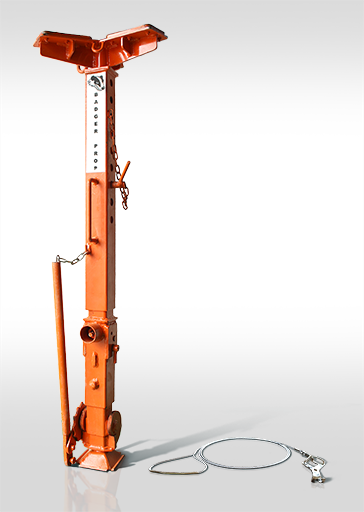
The Badger Prop is a temporary support unit designed for practical underground use — quick to install in the working area, recoverable so it can be used freely rather than rationed, and suited to the conditions where ground has to be held safely until permanent support is in place.
Because water is usually what turned sound ground into difficult ground, temporary support works best alongside the water controls in this handbook: keep the footwall drained, keep flow off the bearing points, and the support does the job it was installed to do.
Equipment covered in this guide
Common questions
- Why does wet ground need different support decisions?
- Water washes fines from joints, softens the footwall and accelerates deterioration of exposed faces. Blocks that were keyed in become free to move and bearing points lose capacity, so support adequate in dry conditions may not be adequate wet.
- Why do props lose tension underground?
- Most commonly because the footwall bearing point has softened and the prop has punched in, or because the ground it is loading has moved. Both are more likely where water is running past the installation.
- How should a prop be installed on soft footwall?
- Prepare and firm the bearing point first, spread the load where possible, install square to the load, and re-check tension after the ground has had time to settle.
- Should temporary support be recoverable?
- Yes. Support that cannot be recovered is used sparingly because of cost, and support used sparingly does not protect people. Recoverability is a safety characteristic, not just a commercial one.
- How often should temporary support be inspected in wet conditions?
- More often than in dry ground, and on the same walk as the water controls. Deteriorating ground shortens the safe interval, and the water problem usually needs fixing before the support can hold.
Dealing with this on your mine?
Tell us what the section looks like and where the water is collecting. We will come back with a practical recommendation and an indication of cost.
Request a recommendation